Giving AI hands.
A mind that can only talk is a counselor. Give it hands and it becomes a colleague. MCP is how the hands get built — this page teaches the techniques.
The loop.
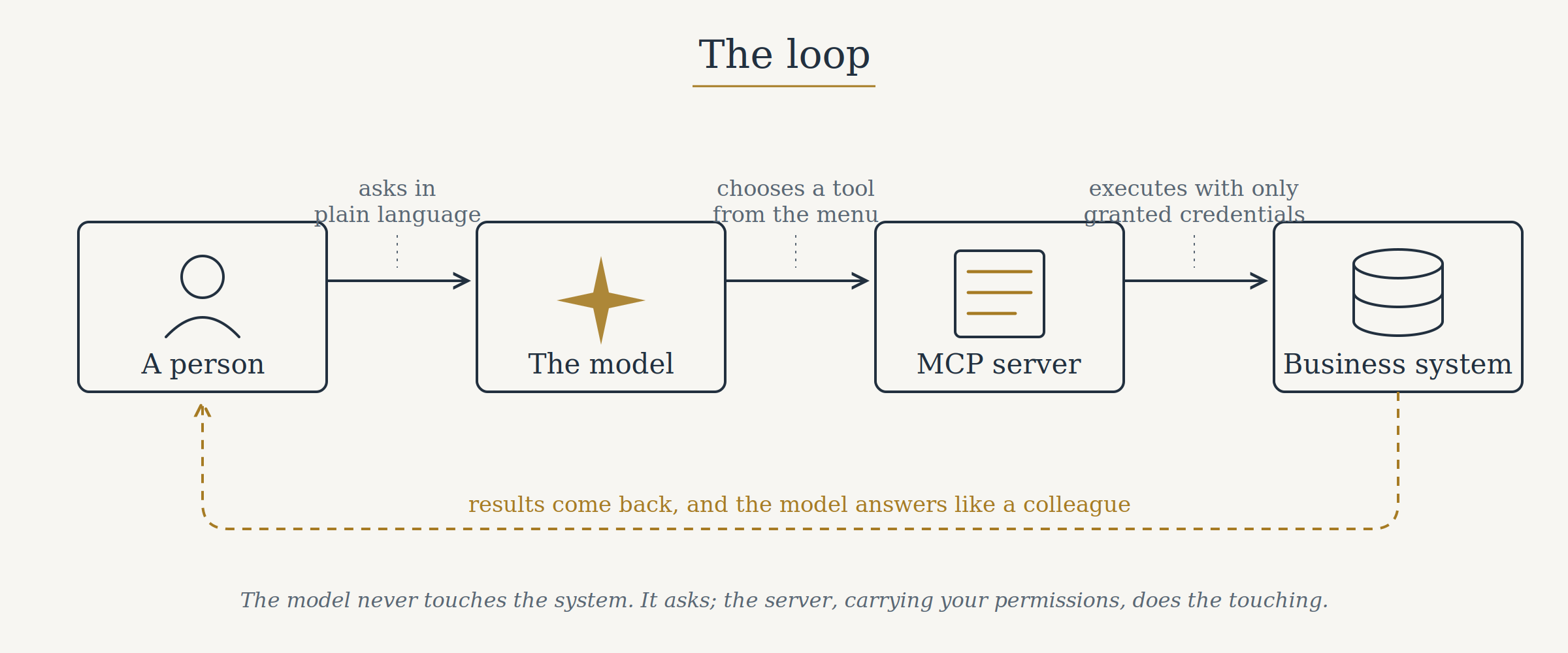
An MCP server is a small program that hands an AI a menu of safe, well-described actions over one system. Every connection, whatever the target, runs the same five beats:
- Advertise. The server declares its tools — names, descriptions, inputs. This text is the model's only knowledge of what's possible, so it's written with care.
- Ask. A person makes a request in plain language. No commands, no syntax.
- Choose. The model matches the request to a tool and fills in the inputs. Nobody hardcoded this decision.
- Execute. The server does the real work — API call, query, file write — using only the credentials it was granted.
- Answer. Results return to the model, which replies like a colleague, not a terminal.
Fourteen ways in.
The MCP layer is the same every time. The craft is underneath: how the server reaches the target system. Three families cover it.
Systems that welcome visitors
Modern software with a published interface. Ask politely, receive answers.
- API wrapper
- Auth plus endpoint calls. The default for help desks, ledgers, chat tools.an agent that finds tickets aging past their SLA and drafts the apologies.
- Delegated identity
- OAuth lets the server act as one specific person, with exactly their permissions, revocably.an assistant that reads your inbox and calendar — yours, not the company's.
- Query language / SDK
- Same courtesy, better grammar: request precisely the fields needed, nothing more.pulling three fields from a sprawling GraphQL schema in one round trip.
- Webhook
- Inverts the arrow — the system calls you when something happens, so nothing polls.a P1 ticket lands at 2 a.m. and triage starts before anyone wakes.
- Message bus
- Systems that share a bulletin board instead of talking. The agent becomes another reader or writer.consuming order events off a queue and flagging the anomalies.
Systems with no front door
Older, stubborn, or sealed software. You learn other ways in.
- Command line
- Slide instructions under the door: write input files, invoke the executable, collect what comes back.a card-deck tool with no API, driven by a script and CSV the agent edits, then renders.
- File exchange
- Watched folders and scheduled drops. Unfashionable, everywhere, and often the only path governance will bless.a nightly export lands; the agent reconciles it and files the exceptions before morning.
- Direct database
- Skip the application, query the data — read-only, always. Fastest when the question is about the data itself."which clients went quiet this quarter?" answered straight from the warehouse.
- In-app bridge
- Plant a small envoy inside the running application — a plugin on a socket — and speak to it from outside.a virtual tabletop takes requests: build tonight's journal entries from session notes.
- Browser automation
- A robot uses the website like a human: clicks, types, reads. Fragile — rearrange the page and it walks into walls.filing a form on a vendor portal that offers no other access.
- Screen automation
- The same robot for desktop programs older than their users. The true last resort.keying invoices into a green-screen ERP nobody dares replace.
Building with what's already built
The wisest technique is sometimes restraint.
- Automation platform
- The tool just rings a bell; a workflow someone already assembled in n8n or Make does the labor.one tool call triggers a twelve-step onboarding sequence across four systems.
- Vendor servers
- Software makers now ship their own MCP servers. The craft shifts from building to evaluating: which deserve write access, which need a governor.vetting a CRM vendor's server before it touches customer records.
- Gateway mediation
- Route every agent call through one checkpoint for identity, rate limits, and an honest logbook.the audit trail that turns a clever demo into something compliance can love.
The order of doors.
Given a new system, try the entrances in order of grace. Each step down trades elegance for reach.
The skill worth hiring is knowing the whole staircase — and never descending further than the job requires.
What a demo is made of.
The code is the smallest part of a convincing demonstration. Roughly: